Saturday, 27 April 2013

Antonie van Leeuwenhoek


Antonie van Leeuwenhoek

Jan Verkolje - Antonie van Leeuwenhoek.jpgAntonie Philips van Leeuwenhoek (in Dutch also Anthonie, Antoni, or Theunis, in English, Antony or Anton;[1] /ˈlvənhʊk/,Dutch: [ɑnˈtoːni vɑn ˈleːuə(n)ˌɦuk] ( listen); October 24, 1632 – August 26, 1723) was a Dutch tradesman and scientist from Delft,Netherlands. He is commonly known as "the Father of Microbiology", and considered to be the first microbiologist. He is best known for his work on the improvement of the microscope and for his contributions towards the establishment of microbiology. Using his handcrafted microscopes, he was the first to observe and describe single-celled organisms, which he originally referred to asanimalcules, and which are now referred to as microorganisms. He was also the first to record microscopic observations of musclefibers, bacteriaspermatozoa, and blood flow in capillaries (small blood vessels). Van Leeuwenhoek did not author any books, although he did write many letters. 


Early involvement with the microscope


Replica of microscope by Van Leeuwenhoek
Van Leeuwenhoek's interest in microscopes and a familiarity with glass processing led to one of the most significant, and simultaneously well-hidden, technical insights in the history of science. By placing the middle of a small rod of soda lime glass in a hot flame, Van Leeuwenhoek could pull the hot section apart to create two long whiskers of glass. Then, by reinserting the end of one whisker into the flame, he could create a very small, high-quality glass sphere. These spheres became the lenses of his microscopes, with the smallest spheres providing the highest magnifications. An experienced businessman, Leeuwenhoek realized that if his simple method for creating the critically important lens was revealed, the scientific community of his time would likely disregard or even forget his role in microscopy. He therefore allowed others to believe that he was laboriously spending most of his nights and free time grinding increasingly tiny lenses to use in microscopes, even though this belief conflicted both with his construction of hundreds of microscopes and his habit of building a new microscope whenever he chanced upon an interesting specimen that he wanted to preserve. He made about 200 microscopes with different magnification.
Van Leeuwenhoek used samples and measurements to estimate numbers of 
microorganisms in units of water.[2][3] He also made good use of the huge lead provided by his method. He studied a broad range of microscopic phenomenae, and shared the resulting observations freely with groups such as the English Royal Society.[4] Such work firmly established his place in history as one of the first and most important explorers of the microscopic world. He was one of the first people to discover cells, along with Robert Hooke.

Eventual recognition by the Royal Society of London


Sir William Davidson of Curriehill had appointed Anthonie van Leeuwenhoek in 1648 as his assistant. Van Leeuwenhoek left after six years.[5][6] (By Abraham van den Tempel, 1664)
After developing his method for creating powerful lenses and applying them to study of the microscopic world, Van Leeuwenhoek was introduced via correspondence to the Royal Society of London by the famous Dutch Physician Reinier de Graaf. He soon began to send copies of his recorded microscopic observations to the Royal Society. In 1673, his earliest observations were published by the Royal Society in its journal: Philosophical Transactions. Amongst those published were Van Leeuwenhoek's accounts of bee mouthparts and stings.
Despite the initial success of Van Leeuwenhoek's relationship with the Royal Society, this relationship was soon severely strained. In 1676, his credibility was questioned when he sent the Royal Society a copy of his first observations of microscopic single-celled organisms. Previously, the existence of single-celled organisms was entirely unknown. Thus, even with his established reputation with the Royal Society as a reliable observer, his observations of microscopic life were initially met with skepticism. Eventually, in the face of Van Leeuwenhoek's insistence, the Royal Society arranged for Alexander Petrie, minister to the English Reformed Church in Delft, Benedict Haan, at that time Lutheran minister at Delft, and Henrik Cordes, then Lutheran minister at the Hague, accompanied by Sir Robert Gordon (later third baronet of Gordonstoun) and four others to determine whether it was in fact Van Leeuwenhoek's ability to observe and reason clearly, or perhaps the Royal Society's theories of life itself that might require reform. Finally in 1680, Van Leeuwenhoek's observations were fully vindicated by the Society.[7]

Antonie van Leeuwenhoek is buried in the Oude kerk in Delft
Van Leeuwenhoek's vindication resulted in his appointment as a Fellow of the Royal Society in that year. After his appointment to the Society, he wrote approximately 560 letters to the Society and other scientific institutions over a period of 50 years. These letters dealt with the subjects he had investigated. Even when dying, Van Leeuwenhoek kept sending letters full of observations to London. The last few also contained a precise description of his own illness. He suffered from a rare disease, an uncontrolled movement of the midriff, which is now named Van Leeuwenhoek's disease.[8] He died at the age of 90, on August 26, 1723 and was buried four days later in theOude Kerk (Delft).
In 1981 the British microscopist Brian J. Ford found that Van Leeuwenhoek's original specimens had survived in the collections of the Royal Society of London.[9] They were found to be of high quality, and were all well preserved. Ford carried out observations with a range of microscopes, adding to our knowledge of Van Leeuwenhoek's work.

Discoveries


Microscopic section through one-year-old ash tree (Fraxinus) wood, drawing made by Van Leeuwenhoek.
Van Leeuwenhoek made more than 500 optical lenses. He also created at least 25 microscopes, of differing types, of which only nine survived. His microscopes were made of silver or copper frames, holding hand-made lenses. Those that have survived are capable of magnification up to 275 times. It is suspected that Van Leeuwenhoek possessed some microscopes that could magnify up to 500 times. Although he has been widely regarded as a dilettante or amateur, his scientific research was of remarkably high quality.[10]
Van Leeuwenhoek's main discoveries are:
  • the infusoria (protists in modern zoological classification), in 1674
  • the bacteria, (e.g., large Selenomonads from the human mouth), in 1676
  • the vacuole of the cell.
  • the spermatozoa in 1677.
  • the banded pattern of muscular fibers, in 1682.[11]
In 1687 he reported his research on the coffee bean. He roasted the bean, cut it into slices and saw a spongeous interior. The bean was pressed, and an oil appeared. He boiled the coffee with rain water twice, set it aside (and probably drank it slowly).[12]
He was visited by Leibniz, William III of Orange and his wife, the Amsterdam burgemeester (the mayor) Johan Huydecoper, the latter very interested in collecting and growing plants for the Hortus Botanicus Amsterdam and all gazed at the tiny creatures. Nicolaes Witsen sent him a map of Tartaria and a mineral found near the origin of the river Amur.[13] In 1698 Van Leeuwenhoek was invited in the boat of tsar Peter the Great. On the occasion Van Leeuwenhoek presented the tsar an "eel-viewer", so Peter could study the blood circulation, whenever he wanted.
Like Robert Boyle and Nicolaas Hartsoeker, Van Leeuwenhoek was interested in the dried cochineal, trying to find out if the dye came from a berry or an insect.[14][15][16]

Lenses secret


Van Leeuwenhoek's microscopes byHenry Baker
Van Leeuwenhoek maintained throughout his life that there are aspects of microscope construction "which I only keep for myself", in particular his most critical secret of how he created lenses. For many years no-one was able to reconstruct Van Leeuwenhoek's design techniques. However, in 1957 C.L. Stong used thin glass thread fusing instead of polishing, and successfully created some working samples of a Leeuwenhoek design microscope.[17] Such a method was also discovered independently by A. Mosolov and A. Belkin at the Russian Novosibirsk State Medical Institute.[18]

Religious interpretations of his discoveries

Van Leeuwenhoek was a Dutch Reformed Calvinist.[19] He often referred with reverence to the wonders God designed in making creatures great and small. He believed that his amazing discoveries were merely further proof of the great wonder of God's creation.[20][21]

The Geographer by Johannes Vermeer
Van Leeuwenhoek's discovery that smaller organisms procreate similarly to larger organisms challenged the contemporary belief, generally held by the 17th-century scientific community, that such organisms generated spontaneously. The position of the Church on the exact nature of the spontaneous generation of smaller organisms was ambivalent.[citation needed]

Possible Vermeer connection

Van Leeuwenhoek was a contemporary of another famous Delft citizen, painter Johannes Vermeer, who was baptized just four days earlier. It has been suggested that he is the man portrayed in two of Vermeer's paintings of the late 1660s, The Astronomer and The Geographer. However, others argue that there appears to be little physical similarity. Because they were both relatively important men in a city with only 24,000 inhabitants, it is likely that they were at least acquaintances. Also, it is known that Van Leeuwenhoek acted as the executor of the will when the painter died in 1675.[22]
In A Short History of Nearly Everything (p. 236) Bill Bryson alludes to rumors that Vermeer's mastery of light and perspective came from use of a camera obscura produced by Van Leeuwenhoek. This is one of the examples of the controversial Hockney–Falco thesis, which claims that some of the Old Masters used optical aids to produce their masterpieces.

FROM: WIKIPEDIA.ORG

Isaac Newton

Isaac Newton
Portrait of man in black with shoulder-length, wavy brown hair, a large sharp nose, and a distracted gaze
Sir Isaac Newton PRS MP (25 December 1642 – 20 March 1727) was an English physicist and mathematician who is widely regarded as one of the most influential scientists of all time and as a key figure in the scientific revolution. His book Philosophiæ Naturalis Principia Mathematica ("Mathematical Principles of Natural Philosophy"), first published in 1687, laid the foundations for most ofclassical mechanics. Newton also made seminal contributions to optics and shares credit with Gottfried Leibniz for the invention of theinfinitesimal calculus.
Newton's Principia formulated the laws of motion and universal gravitation that dominated scientists' view of the physical universe for the next three centuries. It also demonstrated that the motion of objects on the Earth and that of celestial bodies could be described by the same principles. By deriving Kepler's laws of planetary motion from his mathematical description of gravity, Newton removed the last doubts about the validity of the heliocentric model of the cosmos.
Newton built the first practical reflecting telescope and developed a theory of colour based on the observation that a prism decomposes white light into the many colours of the visible spectrum. He also formulated an empirical law of cooling and studied the speed of sound. In addition to his work on the calculus, as a mathematician Newton contributed to the study of power series, generalised thebinomial theorem to non-integer exponents, and developed Newton's method for approximating the roots of a function.
Newton was a fellow of Trinity College and the second Lucasian Professor of Mathematics at the University of Cambridge. He was a devout but unorthodox Christian and, unusually for a member of the Cambridge faculty, he refused to take holy orders in the Church of England, perhaps because he privately rejected the doctrine of trinitarianism. In addition to his work on the mathematical sciences, Newton also dedicated much of his time to the study of alchemy and biblical chronology, but most of his work in those areas remained unpublished until long after his death. In his later life, Newton became president of the Royal Society. He also served the British government as Warden and Master of the Royal Mint.

Early life

Isaac Newton was born (according to the Julian calendar in use in England at the time) on Christmas Day, 25 December 1642, (NS 4 January 1643.[1]) atWoolsthorpe Manor in Woolsthorpe-by-Colsterworth, a hamlet in the county of Lincolnshire. He was born three months after the death of his father, a prosperous farmer also named Isaac Newton. Born prematurely, he was a small child; his mother Hannah Ayscough reportedly said that he could have fit inside a quart mug (≈ 1.1 litres). When Newton was three, his mother remarried and went to live with her new husband, the Reverend Barnabus Smith, leaving her son in the care of his maternal grandmother, Margery Ayscough. The young Isaac disliked his stepfather and maintained some enmity towards his mother for marrying him, as revealed by this entry in a list of sins committed up to the age of 19: "Threatening my father and mother Smith to burn them and the house over them."[8] Although it was claimed that he was once engaged,[9] Newton never married.

Newton in a 1702 portrait byGodfrey Kneller

Isaac Newton (Bolton, Sarah K. Famous Men of Science. NY: Thomas Y. Crowell & Co., 1889)
From the age of about twelve until he was seventeen, Newton was educated at The King's School, Grantham. He was removed from school, and by October 1659, he was to be found at Woolsthorpe-by-Colsterworth, where his mother, widowed by now for a second time, attempted to make a farmer of him. He hated farming.[10] Henry Stokes, master at the King's School, persuaded his mother to send him back to school so that he might complete his education. Motivated partly by a desire for revenge against a schoolyard bully, he became the top-ranked student.[11] The Cambridge psychologist Simon Baron-Cohen considers it "fairly certain" that Newton had Asperger syndrome.[12]
In June 1661, he was admitted to Trinity College, Cambridge as a sizar – a sort of work-study role.[13] At that time, the college's teachings were based on those of Aristotle, whom Newton supplemented with modern philosophers, such as Descartes, and astronomers such as Copernicus,Galileo, and Kepler. In 1665, he discovered the generalised binomial theorem and began to develop a mathematical theory that later becameinfinitesimal calculus. Soon after Newton had obtained his degree in August 1665, the university temporarily closed as a precaution against theGreat Plague. Although he had been undistinguished as a Cambridge student,[14] Newton's private studies at his home in Woolsthorpe over the subsequent two years saw the development of his theories on calculus,[15] optics and the law of gravitation. In 1667, he returned to Cambridge as a fellow of Trinity.[16] Fellows were required to become ordained priests, something Newton desired to avoid due to his unorthodox views. Luckily for Newton, there was no specific deadline for ordination, and it could be postponed indefinitely. The problem became more severe later when Newton was elected for the prestigious Lucasian Chair. For such a significant appointment, ordaining normally could not be dodged. Nevertheless, Newton managed to avoid it by means of a special permission from Charles II (see "Middle years" section below).

Middle years

Mathematics

Newton's work has been said "to distinctly advance every branch of mathematics then studied".[17] His work on the subject usually referred to as fluxions or calculus, seen in a manuscript of October 1666, is now published among Newton's mathematical papers.[18] The author of the manuscript De analysi per aequationes numero terminorum infinitas, sent by Isaac Barrow to John Collins in June 1669, was identified by Barrow in a letter sent to Collins in August of that year as:[19]
Mr Newton, a fellow of our College, and very young ... but of an extraordinary genius and proficiency in these things.
Newton later became involved in a dispute with Leibniz over priority in the development of infinitesimal calculus (the Leibniz–Newton calculus controversy). Most modern historians believe that Newton and Leibniz developed infinitesimal calculus independently, although with very different notations. Occasionally it has been suggested that Newton published almost nothing about it until 1693, and did not give a full account until 1704, while Leibniz began publishing a full account of his methods in 1684. (Leibniz's notation and "differential Method", nowadays recognised as much more convenient notations, were adopted by continental European mathematicians, and after 1820 or so, also by British mathematicians.) Such a suggestion, however, fails to notice the content of calculus which critics of Newton's time and modern times have pointed out in Book 1 of Newton's Principia itself (published 1687) and in its forerunner manuscripts, such as De motu corporum in gyrum ("On the motion of bodies in orbit"), of 1684. The Principia is not written in the language of calculus either as we know it or as Newton's (later) 'dot' notation would write it. But his work extensively uses an infinitesimal calculus in geometric form, based on limiting values of the ratios of vanishing small quantities: in the Principia itself Newton gave demonstration of this under the name of 'the method of first and last ratios'[20] and explained why he put his expositions in this form,[21] remarking also that 'hereby the same thing is performed as by the method of indivisibles'.
Because of this, the Principia has been called "a book dense with the theory and application of the infinitesimal calculus" in modern times[22] and "lequel est presque tout de ce calcul" ('nearly all of it is of this calculus') in Newton's time.[23] His use of methods involving "one or more orders of the infinitesimally small" is present in his De motu corporum in gyrum of 1684[24] and in his papers on motion "during the two decades preceding 1684".[25]
Newton had been reluctant to publish his calculus because he feared controversy and criticism.[26] He was close to the Swiss mathematician Nicolas Fatio de Duillier. In 1691, Duillier started to write a new version of Newton's Principia, and corresponded with Leibniz.[27] In 1693 the relationship between Duillier and Newton deteriorated, and the book was never completed.
Starting in 1699, other members of the Royal Society (of which Newton was a member) accused Leibniz of plagiarism, and the dispute broke out in full force in 1711. The Royal Society proclaimed in a study that it was Newton who was the true discoverer and labelled Leibniz a fraud. This study was cast into doubt when it was later found that Newton himself wrote the study's concluding remarks on Leibniz. Thus began the bitter controversy which marred the lives of both Newton and Leibniz until the latter's death in 1716.[28]
Newton is generally credited with the generalised binomial theorem, valid for any exponent. He discovered Newton's identities, Newton's method, classified cubic plane curves (polynomials of degree three in two variables), made substantial contributions to the theory of finite differences, and was the first to use fractional indices and to employ coordinate geometry to derive solutions to Diophantine equations. He approximated partial sums of the harmonic series by logarithms (a precursor to Euler's summation formula), and was the first to use power series with confidence and to revert power series. Newton's work on infinite series was inspired by Simon Stevin's decimals.[29]
He was appointed Lucasian Professor of Mathematics in 1669 on Barrow's recommendation. In that day, any fellow of Cambridge or Oxford was required to become an ordainedAnglican priest. However, the terms of the Lucasian professorship required that the holder not be active in the church (presumably so as to have more time for science). Newton argued that this should exempt him from the ordination requirement, and Charles II, whose permission was needed, accepted this argument. Thus a conflict between Newton's religious views and Anglican orthodoxy was averted.

FROM: wikipedia.org

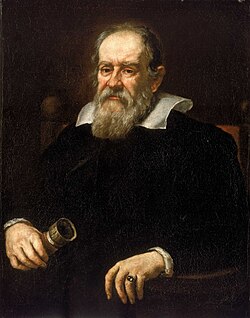
Galileo Galilei

Galileo, in full Galileo Galilei   (born February 15, 1564, Pisa [Italy]—died January 8, 1642, Arcetri, near Florence), Italian natural philosopher, astronomer, and mathematician who made fundamental contributions to the sciences of motion, astronomy, and strength of materials and to the development of the scientific method. His formulation of (circular) inertia, the law of falling bodies, and parabolic trajectories marked the beginning of a fundamental change in the study of motion. His insistence that the book of nature was written in the language of mathematics changed natural philosophy from a verbal, qualitative account to a mathematical one in which experimentation became a recognized method for discovering the facts of nature. Finally, his discoveries with the telescope revolutionized astronomy and paved the way for the acceptance of the Copernican heliocentric system, but his advocacy of that system eventually resulted in an Inquisition process against him.


Early life and career

Galileo was born in Pisa, Tuscany, on February 15, 1564, the oldest son of Vincenzo Galilei, a musician who made important contributions to the theory and practice of music and who may have performed some experiments with Galileo in 1588–89 on the relationship between pitch and the tension of strings. The family moved to Florence in the early 1570s, where the Galilei family had lived for generations. In his middle teens Galileo attended the monastery school at Vallombrosa, near Florence, and then in 1581 matriculated at the University of Pisa, where he was to study medicine. However, he became enamoured with mathematics and decided to make the mathematical subjects and philosophy his profession, against the protests of his father. Galileo then began to prepare himself to teachAristotelian philosophy and mathematics, and several of his lectures have survived. In 1585 Galileo left the university without having obtained a degree, and for several years he gave private lessons in the mathematical subjects in Florence and Siena. During this period he designed a new form of hydrostatic balance for weighing small quantities and wrote a short treatise, La bilancetta (“The Little Balance”), that circulated in manuscript form. He also began his studies on motion, which he pursued steadily for the next two decades.
In 1588 Galileo applied for the chair of mathematics at the University of Bologna but was unsuccessful. His reputation was, however, increasing, and later that year he was asked to deliver two lectures to the Florentine Academy, a prestigious literary group, on the arrangement of the world in Dante’s Inferno. He also found some ingenious theorems on centres of gravity (again, circulated in manuscript) that brought him recognition among mathematicians and the patronage of Guidobaldo del Monte (1545–1607), a nobleman and author of several important works on mechanics. As a result, he obtained the chair of mathematics at the University of Pisa in 1589. There, according to his first biographer, Vincenzo Viviani(1622–1703), Galileo demonstrated, by dropping bodies of different weights from the top of the famousLeaning Tower, that the speed of fall of a heavy object is not proportional to its weight, as Aristotle had claimed. The manuscript tract De motu (On Motion), finished during this period, shows that Galileo was abandoning Aristotelian notions about motion and was instead taking an Archimedean approach to the problem. But his attacks on Aristotle made him unpopular with his colleagues, and in 1592 his contract was not renewed. His patrons, however, secured him the chair of mathematics at the University of Padua, where he taught from 1592 until 1610.
Although Galileo’s salary was considerably higher there, his responsibilities as the head of the family (his father had died in 1591) meant that he was chronically pressed for money. His university salary could not cover all his expenses, and he therefore took in well-to-do boarding students whom he tutored privately in such subjects as fortification. He also sold a proportional compass, or sector, of his own devising, made by an artisan whom he employed in his house. Perhaps because of these financial problems, he did not marry, but he did have an arrangement with a Venetian woman, Marina Gamba, who bore him two daughters and a son. In the midst of his busy life he continued his research on motion, and by 1609 he had determined that the distance fallen by a body is proportional to the square of the elapsed time (the law of falling bodies) and that the trajectory of a projectile is a parabola, both conclusions that contradicted Aristotelian physics.
from:britannica.com